Improving inference and forecasting in VAR models using cross-sectional information

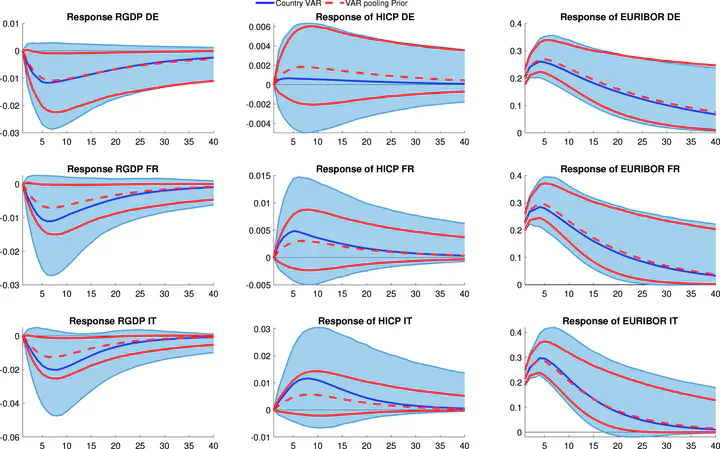
Macroeconomic time series are short, so estimating a individual VARs for many country runs the risk of overfitting and imprecise inference. The standard remedy — the Minnesota prior — shrinks all coefficients towards zero. But this ignores a valuable source of information: many countries exhibit similar dynamics, at least for some variables. Euro area member states, for example, share a common monetary policy, so interest rates and inflation dynamics are strongly integrated, while labour markets and industry structures are very different.
The idea. Together with Jan Prüser, I propose a prior for panels of country-specific VARs that combines both ingredients: the popular Minnesota prior (zero shrinkage) and a flexible pooling prior that pulls the coefficients of each country’s VAR towards those of the other countries. Pooling operates pairwise and coefficient by coefficient, so that only subsets of countries — and only some variables within them — are pooled. How strongly coefficients of two countries are pooled is determined endogenously through a two-step empirical Bayes procedure, which also reveals which country pairs, and hence clusters, exhibit similar dynamics. From a frequentist perspective, the prior penalizes both deviations from zero and deviations between countries’ coefficients — and, because it is pairwise, information also flows indirectly: pooling country 1 with country 2 and country 2 with country 3 implicitly pools country 1 with country 3.
Why both, not just one? Pooling alone borrows strength across countries but can be outperformed by a simple single-country VAR when countries are heterogeneous; zero shrinkage alone borrows no cross-country information at all. We show that the data prefer the combination.
We have three applications that show the strengths of our method and here are the main results to them:
- Structural analysis (10 large euro area countries, 2000Q1–2019Q4): A formal model comparison (deviance information criterion) favors the combination of pooling and zero shrinkage over either zero shrinkage alone or pooling alone. The combined prior yields much narrower credibility intervals: single-country Bayesian VARs cannot distinguish the output response to a contractionary monetary policy shock from zero, whereas the combined prior estimates the effect of an interest rate hike precisely enough that the credibility interval of the output response excludes zero in all periods — under both recursive identification and sign restrictions.
- Monte Carlo experiments (three DGPs, from similar to identical countries): Zero shrinkage and pooling each reduce estimation variance relative to a flat prior, and combining both further increases precision. When countries are similar, pooling introduces only a small bias while delivering large variance reductions.
- Forecasting (15 countries, 1979Q2–2019Q4, horizons up to eight steps ahead): The combination of zero shrinkage and pooling outperforms the Minnesota-prior benchmark in most cases for GDP, inflation, and interest rates — and substantially outperforms popular panel VAR specifications with pooling priors. Approaches that rely on pooling alone, by contrast, often underperform the simple single-country Minnesota VAR, underscoring the importance of zero shrinkage to mitigate overfitting.
If you want to use it in your own research, the replication codes are avaialbel on github.This is the published version of the working paper here.