Does it add up? Reconciling forecasts and Impulse responses for hierarchical macroeconomic data

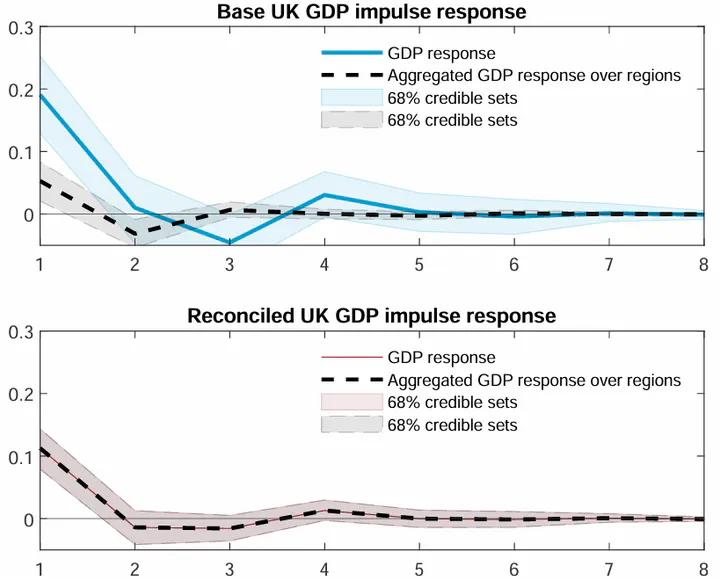
Regional forecasts should add up to the national forecast. In reality they often don’t as each region makes their own forecasts. Also in structural analyses, regional shock responses can drift so far apart from the national response that the numbers no longer add up at all.
In our new working paper, we show how to fix this. Together with Clara Krause, we introduce a method for hierarchical macroeconomic data: the forecasts are made consistent with each other, and at the same time more accurate. Using UK data and state-of-the art techniques that model all regions jointly our density forecasts improve by up to 20%. Using German data and modelling each region individually we get up to 50% lower forecast errors, both point and density. 50% compared to the state-of-the-art models.
Why this matters: budget planning doesn’t wait for the data. Regional governments plan the next fiscal year in Sep-Dec – while the most recent official regional data only goes back to the previous year. Yep, even the current year is not out there when they need a good forecast. Consistent, up-to-date forecasts are therefore not a nice-to-have, but a necessity.